Hello foodies!
Recently, I was tempted. A sleek number, with smooth lines and a powerful motor - definitely some muscle there! Yes, it was a Kitchenaid stand mixer. I was in Target, for the first and last time, and there were two different models, deeply discounted. I was torn. Buy? If so, which one? I hadn't done my research, and research is need. Even deeply discounted, a stand mixer is a big kitchen purchase. Ultimately, I wasn't ready to pull the trigger. There will be other days, other sales, when I am more prepared. but it got me thinking about kitchen gadgets, gizmos, and doo-dads.
As you know, there are SO MANY KITCHEN GADGETS. Many of them sound, and look, cool. You look at them and think, "I would totally use that! ALL THE TIME!! But would you? Really?? That microwave poached egg cup is essential to your kitchen? I have a long history of buying cool gizmos that I use twice and then forget about. Except when I bump into them in a crowded drawer or cupboard while looking for something else, or curse the lack of counter space and growing clutter.
As I became more skilled and focused in my cooking, I decluttered. I divested myself of those speciality unitaskers (to borrow a word from the inimitable Alton Brown). Why do I need a difficult to clean garlic press and a Pampered Chef slap chopper when a chef's knife can do more efficiently what the other items can, plus SO MUCH MORE!!
Now, before buying, I weigh the use factor against the space factor. My kitchen is small. Counter space is at a premium. I try not to buy unitaskers (items that serve only one purpose) unless they are really, really great. Not all unitaskers are bad. Beyond a fire extinguisher, thankfully never used, I have a couple of unitaskers that are well loved. My raclette grill, a gift from my sister several years ago. My lever-style cork screw. There is a place for certain unitaskers.
One unitasker I am currently considering is a paella pan. After trial and trial and trial, with much error, I have come to the conclusion that I cannot get the result I want without the proper, unitasking pan. The delightfully toasted rice that is really the whole point of paella is not possible with cast iron, which burns; or non-stick, which doesn't toast; or a regular aluminium pan, which, though the best of a bad lot, still doesn't produce the effect I am after. A paella pan allows the rice on the bottom to delicately toast without overcooking anything else. So now I am on the lookout for the perfect paella pan.
The Kitchenaid mixer... it will come. Then there will be pasta, and sausage, and countless other delights. And I will continue to peruse kitchen stores for ideas. When I find that paella pan.... expect a post.
For updates and observations... follow me on Twitter! @culinarykira
Saturday, 28 March 2015
Saturday, 14 February 2015
Breakfast at work (Baked Oatmeal!)
Hello foodies,
I do not like getting up in the morning. Over the years, I have worked my morning routine down to the millisecond so that I can spend every possible minute in bed. I also do not like eating as soon as I get up, so I usually eat at my desk as I am planning my day.
My building has a cafeteria. They struggle with toast, so the less said about it the better. And buying meals daily adds up, and takes my valuable eating out dollars away from better fare. So, today, I would like to share some thoughts on things I bring from home.
Breakfast
I detest cereal. In my memory, I have never once eaten it - at least, not in a bowl with milk poured over it the way many do. I can't even be near people when they're eating cereal. The smell, the sound, and the look of it turn me off completely. So this aversion of mine has always made quick, week day breakfasts more of a challenge for me. Beyond the obvious - dinner leftovers - I have several standbys I like.
Greek yogurt, walnuts and honey. I discovered this a few years ago travelling in Greece. You get protein from the yogurt and nuts, dairy, a little sweetness from the honey. You can add fruit or berries as well. Granola would work instead of nuts. Or in addition to it. When I get to work, I actually pop it in the freezer for a bit (I like my yogurt really cold, so this addresses any warming issues that happened on my commute). Sometimes, I leave it a little long and it freezes a little, so I have nutty frozen yogurt for breakfast, which is awesome.
Another thing I discovered recently that is really easy to do at work is miso soup. A savoury soup for breakfast sounds strange to many Canadians, but it is quite common elsewhere, and in the winter, it is lovely. It is as easy as bringing a chink of miso paste in tupperware, and pouring hot water over it and stirring. You can get fancier, with chopped scallions and tofu, and use dashi instead of plain water. But the plain water really does the trick. Pictured below is a my first homemade miso. Here I had made the dashi from scratch, but after that was gone, I reverted to water, and at work it was just fine.
I have recently heard about baked oatmeal. And I decided I wanted to try. It can be made individually and frozen for weekday breakfasts, or in a larger cake pan for a communal weekend option. I started researching, and found a lot of recipes. Many of them gluten free and/or vegan, calling for things like applesauce or mashed bananas. Stuff that I am not going to do. So, having an idea what I wanted, what I have in my fridge, and what the batter and the finished product should look like, I set out to tailor the concept to me.
Combine:
2 c rolled oats (not quick oats)
1/4 c flour
1 tsp baking powder
1/2 tsp salt
Walnut pieces to taste, so they're well distributed (or pecan, or almond, or....)
Add:
1/4 c maple syrup (or a little more - I was using a 1/3 measure that I didn't fill all the way)
1 c milk
1 egg
1/2 of sour cream
1 tbsp melted butter
1 tsp vanilla
Mix until combined.
Spoon into paper lined muffin tin, top with mixed berries (or more nuts, or chocolate chips, or....) and bake at 375 for 40 minutes.
All in all, not bad. Fibre, a bit of protein from the nuts. Some fruit. One flaw is they kind of stick to the wrappers. I shall update when I find a way around that. I may tinker with the recipe a bit - and you can too = it is very forgiving.
For updates, follow me on twitter! @culinarykira
I do not like getting up in the morning. Over the years, I have worked my morning routine down to the millisecond so that I can spend every possible minute in bed. I also do not like eating as soon as I get up, so I usually eat at my desk as I am planning my day.
My building has a cafeteria. They struggle with toast, so the less said about it the better. And buying meals daily adds up, and takes my valuable eating out dollars away from better fare. So, today, I would like to share some thoughts on things I bring from home.
Breakfast
I detest cereal. In my memory, I have never once eaten it - at least, not in a bowl with milk poured over it the way many do. I can't even be near people when they're eating cereal. The smell, the sound, and the look of it turn me off completely. So this aversion of mine has always made quick, week day breakfasts more of a challenge for me. Beyond the obvious - dinner leftovers - I have several standbys I like.
Greek yogurt, walnuts and honey. I discovered this a few years ago travelling in Greece. You get protein from the yogurt and nuts, dairy, a little sweetness from the honey. You can add fruit or berries as well. Granola would work instead of nuts. Or in addition to it. When I get to work, I actually pop it in the freezer for a bit (I like my yogurt really cold, so this addresses any warming issues that happened on my commute). Sometimes, I leave it a little long and it freezes a little, so I have nutty frozen yogurt for breakfast, which is awesome.
Another thing I discovered recently that is really easy to do at work is miso soup. A savoury soup for breakfast sounds strange to many Canadians, but it is quite common elsewhere, and in the winter, it is lovely. It is as easy as bringing a chink of miso paste in tupperware, and pouring hot water over it and stirring. You can get fancier, with chopped scallions and tofu, and use dashi instead of plain water. But the plain water really does the trick. Pictured below is a my first homemade miso. Here I had made the dashi from scratch, but after that was gone, I reverted to water, and at work it was just fine.
I have recently heard about baked oatmeal. And I decided I wanted to try. It can be made individually and frozen for weekday breakfasts, or in a larger cake pan for a communal weekend option. I started researching, and found a lot of recipes. Many of them gluten free and/or vegan, calling for things like applesauce or mashed bananas. Stuff that I am not going to do. So, having an idea what I wanted, what I have in my fridge, and what the batter and the finished product should look like, I set out to tailor the concept to me.
Combine:
2 c rolled oats (not quick oats)
1/4 c flour
1 tsp baking powder
1/2 tsp salt
Walnut pieces to taste, so they're well distributed (or pecan, or almond, or....)
Add:
1/4 c maple syrup (or a little more - I was using a 1/3 measure that I didn't fill all the way)
1 c milk
1 egg
1/2 of sour cream
1 tbsp melted butter
1 tsp vanilla
Mix until combined.
Spoon into paper lined muffin tin, top with mixed berries (or more nuts, or chocolate chips, or....) and bake at 375 for 40 minutes.
All in all, not bad. Fibre, a bit of protein from the nuts. Some fruit. One flaw is they kind of stick to the wrappers. I shall update when I find a way around that. I may tinker with the recipe a bit - and you can too = it is very forgiving.
For updates, follow me on twitter! @culinarykira
Saturday, 24 January 2015
Eleven Madison Park
Hello foodies!
In November, I went to foodie heaven. A 3 Michelin starred restaurant in New York City. Ranked 4th in the world by San Pellegrino in their annual rankings - the top in North America. Eleven Madison Park.
Anyone who loves food, and loves innovation, should try an experience like this at least once, if they can possibly afford it. They serve a 15 course tasting menu, with optional beverage pairings. No menu to order from, though there are some choices to be made.
To me, it was a perfect evening. Beautiful, interesting, tasty food, carefully paired drink, and service unlike any I have experienced. Plus the good company of my sister in one of the most vibrant cities in the world. This place starts taking reservations at 9:00 am EST, 4 weeks prior to the night in question. So I called at 9:00 am, 28 days prior to November 11th. A couple of weeks before our dinner, I received an email from the head waiter, asking about dietary restrictions, allergies, and if there was anything he could do to enhance our visit. A nice touch.
My dining companion was my sister, K. We had a long-planned trip to New York as a celebration of a milestone birthday for me (40!), and this dinner was the pinnacle of my trip. We arrived a little early and were taken to the bar to wait. There, the bartender questioned us on our preferences and crafted a cocktail to cater to those preferences. Mine, on the left, was tart with citrus, not too sweet.
Then we were seated. The room is large. High ceilings. Art deco grandeur. We were among the first diners there (the meal takes a good 4 hours, so starting around 6 seemed like a good idea), and it seemed to us that there were many, many servers based on the number of possible seats. This allows them to offer a level of service that I have never before experienced. The staff truly anticipate your needs, enhancing your dining experience. I think many of us have the viewpoint that being a waiter is a stopping point, something you do to make ends meet as a student, an actor, an artist, etc., rather than a profession. And in most places in Canada this is the case. Here, the waitstaff are professionals, and it shows. (Aside.... in general, I must say the service in NYC was far and above anything I have ever seen in Canada - from store clerks, to waitstaff, to ticket takers, people were so friendly and kind, whether it was a role where tips were a possibility or not.)
Upon being seated, we were brought their signature black and white cookies, which both start and end the meal. The opening cookies are savoury, the closing cookies are sweet. The opening cookies, which I sadly neglected to take a picture of, were cheddar cheese with apple. We were asked to choose our protein - duck or venison. After a short discussion, we chose venison. It isn't as commonly found in grocery stores and on menus here in Ontario, particularly in K's medium-sized town, so we felt it might be the more interesting option. Personally, I also frequently cook duck and cook it well. I know venison, because of its leanness, is more challenging. This default preference to things I can't cook easily made our second choice for us: for the foie gras course, did we want the foie seared or torchon? I can, and have, seared foie gras at home, but foie gras torchon is a labour intensive 2 - 4 day process requiring much more (expensive) foie to start with, so our choice was obvious. Also in front of us was an envelope with two cards inside, each with 4 punch outs with a flavour profile written underneath. Maple, cranberry, apple, and celery. We each were able to choose the flavour profile that would be reflected later in our meal. We punched our cards. I chose cranberry, liking the idea of the tartness of it, and K was intrigued by the idea of celery.
I figure that you don't do an expensive, splurge dinner like this without being willing to go all in. So we went all in. There are two options for the beverage pairing. The premium pairing features more difficult to find, less common, less available, or just plain better wines (mostly, there was beer with one course as well). So, naturally, we went with the premium.
The first thing brought, also not pictured, was a cup of venison broth (the first reflection of our protein choice), with bread and butter. This was savoury and intensely flavoured, and got us ready for the march of culinary delight that was about to commence.
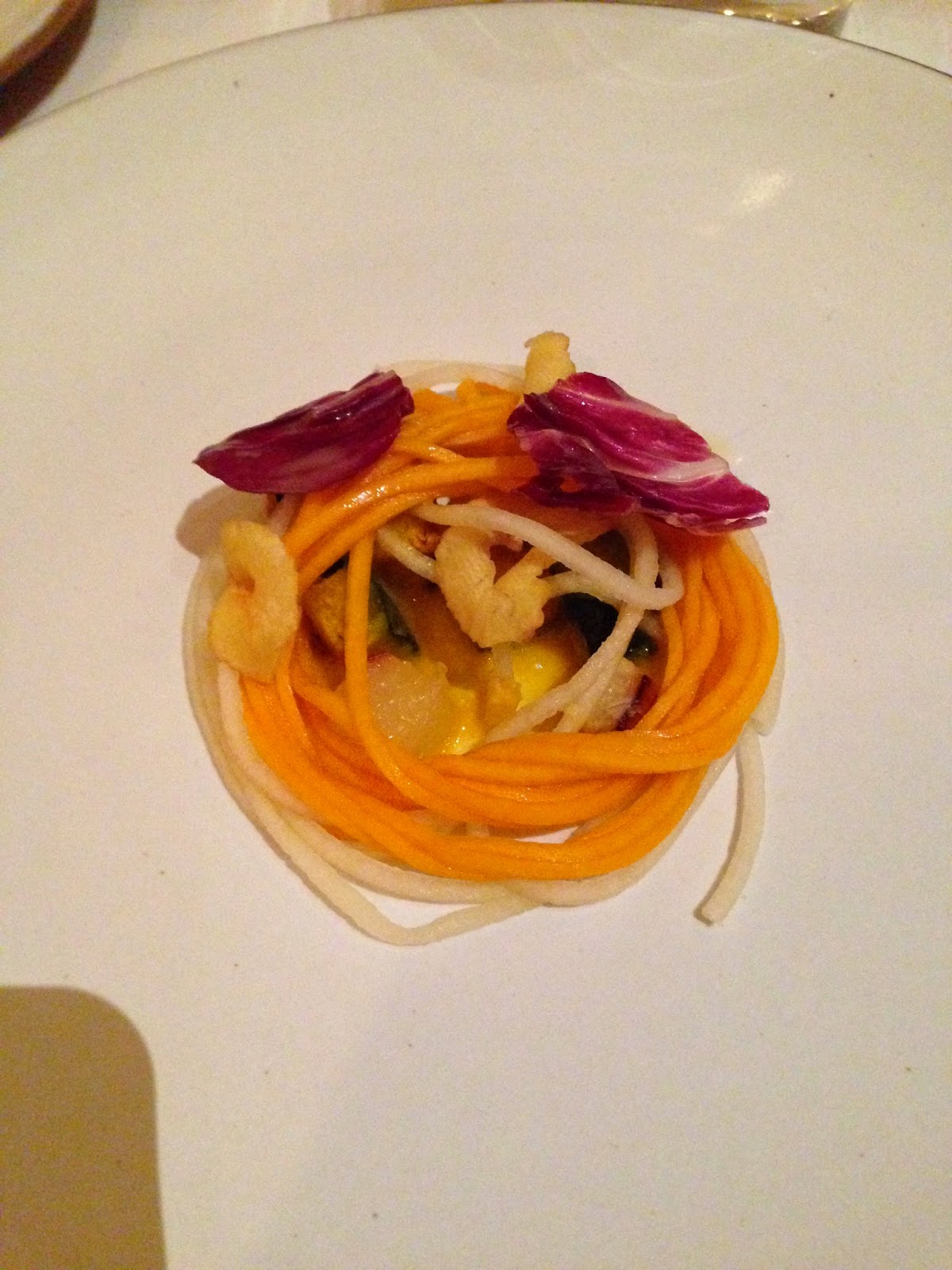
Kabocha squash, roasted with pear, chestnut, and radicchio, paired with the 1989 Hans Kramp Ayler Kupp, from the Saar region in Germany. From a little googling, this wine is quite a find, and we were lucky to get to sample it. Not surprising something like this was first in the liquor line up, before our palates got muddled with food and drink.
Followed by the foie gras, with marinated grapes, truffles, and mushroom and breadcrumbs, served with NY Malmsey. You can see the decadent little cylinders of foie gras torchon beneath the mushrooms. Torchon, by the way, is a preparation where a whole lobe of foie gras is prepared, seasoned, shaped, rolled tightly and bound, then lightly poached at a low temperature, with resting phases in various parts of the process. The result is an unbelievably creamy, smooth, rich texture, with perhaps a slight taming of the liveriness of it all.
The next course honoured a New York tradition: deli. Pastrami on rye, but more elegant and elevated. First, a deli sandwich needs a soda:
My cranberry soda, and K's celery soda. K loved the celery - found it unusual and refreshing. My cranberry was just what I would expect, tart and a little sweet, and nice against the fattiness of the pastrami...
Made in house, this was delightful. Those who have only had pastrami from grocery stores don't know what they're missing. Proper pastrami is so tasty. We assembled our own sandwiches with:
Rye bread. Dollops of different mustards, mayo, charred leeks and fingerling potato chips. All in all, this dish was fun, playful, and, above all, delicious.
The next course involved four different preparations of Long Island seafood, served with Larmandier-Bernier 2008 Blanc de Blancs champagne. Oyster with yogurt and lemon, in a mignonette gelée.This had a nice flavour, but over all, the gelée was not my favourite, and I lost the texture of the oyster.
Scallop with pistachio and apple. The scallop was ceviche style, nice texture and acidity, the apple gave a bit of crunch.
Marinated blue crab with pickled radish. Nice blend between the sweetness of the crab meat and the brine of the pickle.
Vichyssoise with caviar, smoked blue fish, and quail egg. With the caviar and egg yolk, this was the most luxe of this quartet. I loved the saltiness of the caviar, and I enjoy that popping texture of the little roe.
Continuing on the ocean theme, the next dish was striped bass, slow cooked with clams. There was a pool of a squid ink sauce that was very interesting, and a parsley shellfish sauce. This was served with some potato foam/soup and sea urchin (uni!!) in another bowl. This whole combination was one of my favourites. The fish was cooked beautifully, the clams atop it added depth and texture. The squid ink sauce added visual interest and tasted good - I had never had squid ink before. The side, well, foam is foam. But sea urchin. Uni. Long time readers know that I have had uni before and, well, it didn't delight. Much to my surprise, this preparation worked for me. The aggressive fishiness that turned me off before was tamed into a pleasant brine with a hint of iodine. The soup/foam also counteracted the textural issues of pure uni. I am going to take this experience and try uni yet again in sushi form to see if my feelings have changed or if it was just this one dish.
They brought our next course to the table as it was still being cooked, just to show us the technique. An old, old school version of the trendy sous-vide method, celery root, flavourings and aromatics were sealed in a tightly tied pig's bladder and floated gently in a pan of liquid.
It sounds, and looks, strange, I know. But you need an open mind when going to a place like this. The end result was delicious. A ball of celery root in a truffle sauce. Under the white disc of pureed celery root, there is a smaller wheel of black truffle puree, taking the whole dish up a notch. This was paired with a 2011 Domaine du Montille burgundy.
In November, I went to foodie heaven. A 3 Michelin starred restaurant in New York City. Ranked 4th in the world by San Pellegrino in their annual rankings - the top in North America. Eleven Madison Park.
Anyone who loves food, and loves innovation, should try an experience like this at least once, if they can possibly afford it. They serve a 15 course tasting menu, with optional beverage pairings. No menu to order from, though there are some choices to be made.
To me, it was a perfect evening. Beautiful, interesting, tasty food, carefully paired drink, and service unlike any I have experienced. Plus the good company of my sister in one of the most vibrant cities in the world. This place starts taking reservations at 9:00 am EST, 4 weeks prior to the night in question. So I called at 9:00 am, 28 days prior to November 11th. A couple of weeks before our dinner, I received an email from the head waiter, asking about dietary restrictions, allergies, and if there was anything he could do to enhance our visit. A nice touch.
My dining companion was my sister, K. We had a long-planned trip to New York as a celebration of a milestone birthday for me (40!), and this dinner was the pinnacle of my trip. We arrived a little early and were taken to the bar to wait. There, the bartender questioned us on our preferences and crafted a cocktail to cater to those preferences. Mine, on the left, was tart with citrus, not too sweet.
Then we were seated. The room is large. High ceilings. Art deco grandeur. We were among the first diners there (the meal takes a good 4 hours, so starting around 6 seemed like a good idea), and it seemed to us that there were many, many servers based on the number of possible seats. This allows them to offer a level of service that I have never before experienced. The staff truly anticipate your needs, enhancing your dining experience. I think many of us have the viewpoint that being a waiter is a stopping point, something you do to make ends meet as a student, an actor, an artist, etc., rather than a profession. And in most places in Canada this is the case. Here, the waitstaff are professionals, and it shows. (Aside.... in general, I must say the service in NYC was far and above anything I have ever seen in Canada - from store clerks, to waitstaff, to ticket takers, people were so friendly and kind, whether it was a role where tips were a possibility or not.)
Upon being seated, we were brought their signature black and white cookies, which both start and end the meal. The opening cookies are savoury, the closing cookies are sweet. The opening cookies, which I sadly neglected to take a picture of, were cheddar cheese with apple. We were asked to choose our protein - duck or venison. After a short discussion, we chose venison. It isn't as commonly found in grocery stores and on menus here in Ontario, particularly in K's medium-sized town, so we felt it might be the more interesting option. Personally, I also frequently cook duck and cook it well. I know venison, because of its leanness, is more challenging. This default preference to things I can't cook easily made our second choice for us: for the foie gras course, did we want the foie seared or torchon? I can, and have, seared foie gras at home, but foie gras torchon is a labour intensive 2 - 4 day process requiring much more (expensive) foie to start with, so our choice was obvious. Also in front of us was an envelope with two cards inside, each with 4 punch outs with a flavour profile written underneath. Maple, cranberry, apple, and celery. We each were able to choose the flavour profile that would be reflected later in our meal. We punched our cards. I chose cranberry, liking the idea of the tartness of it, and K was intrigued by the idea of celery.
I figure that you don't do an expensive, splurge dinner like this without being willing to go all in. So we went all in. There are two options for the beverage pairing. The premium pairing features more difficult to find, less common, less available, or just plain better wines (mostly, there was beer with one course as well). So, naturally, we went with the premium.
The first thing brought, also not pictured, was a cup of venison broth (the first reflection of our protein choice), with bread and butter. This was savoury and intensely flavoured, and got us ready for the march of culinary delight that was about to commence.
Kabocha squash, roasted with pear, chestnut, and radicchio, paired with the 1989 Hans Kramp Ayler Kupp, from the Saar region in Germany. From a little googling, this wine is quite a find, and we were lucky to get to sample it. Not surprising something like this was first in the liquor line up, before our palates got muddled with food and drink.
Followed by the foie gras, with marinated grapes, truffles, and mushroom and breadcrumbs, served with NY Malmsey. You can see the decadent little cylinders of foie gras torchon beneath the mushrooms. Torchon, by the way, is a preparation where a whole lobe of foie gras is prepared, seasoned, shaped, rolled tightly and bound, then lightly poached at a low temperature, with resting phases in various parts of the process. The result is an unbelievably creamy, smooth, rich texture, with perhaps a slight taming of the liveriness of it all.
The next course honoured a New York tradition: deli. Pastrami on rye, but more elegant and elevated. First, a deli sandwich needs a soda:
My cranberry soda, and K's celery soda. K loved the celery - found it unusual and refreshing. My cranberry was just what I would expect, tart and a little sweet, and nice against the fattiness of the pastrami...
Made in house, this was delightful. Those who have only had pastrami from grocery stores don't know what they're missing. Proper pastrami is so tasty. We assembled our own sandwiches with:
Rye bread. Dollops of different mustards, mayo, charred leeks and fingerling potato chips. All in all, this dish was fun, playful, and, above all, delicious.
The next course involved four different preparations of Long Island seafood, served with Larmandier-Bernier 2008 Blanc de Blancs champagne. Oyster with yogurt and lemon, in a mignonette gelée.This had a nice flavour, but over all, the gelée was not my favourite, and I lost the texture of the oyster.
Scallop with pistachio and apple. The scallop was ceviche style, nice texture and acidity, the apple gave a bit of crunch.
Marinated blue crab with pickled radish. Nice blend between the sweetness of the crab meat and the brine of the pickle.
Vichyssoise with caviar, smoked blue fish, and quail egg. With the caviar and egg yolk, this was the most luxe of this quartet. I loved the saltiness of the caviar, and I enjoy that popping texture of the little roe.
Continuing on the ocean theme, the next dish was striped bass, slow cooked with clams. There was a pool of a squid ink sauce that was very interesting, and a parsley shellfish sauce. This was served with some potato foam/soup and sea urchin (uni!!) in another bowl. This whole combination was one of my favourites. The fish was cooked beautifully, the clams atop it added depth and texture. The squid ink sauce added visual interest and tasted good - I had never had squid ink before. The side, well, foam is foam. But sea urchin. Uni. Long time readers know that I have had uni before and, well, it didn't delight. Much to my surprise, this preparation worked for me. The aggressive fishiness that turned me off before was tamed into a pleasant brine with a hint of iodine. The soup/foam also counteracted the textural issues of pure uni. I am going to take this experience and try uni yet again in sushi form to see if my feelings have changed or if it was just this one dish.
They brought our next course to the table as it was still being cooked, just to show us the technique. An old, old school version of the trendy sous-vide method, celery root, flavourings and aromatics were sealed in a tightly tied pig's bladder and floated gently in a pan of liquid.
It sounds, and looks, strange, I know. But you need an open mind when going to a place like this. The end result was delicious. A ball of celery root in a truffle sauce. Under the white disc of pureed celery root, there is a smaller wheel of black truffle puree, taking the whole dish up a notch. This was paired with a 2011 Domaine du Montille burgundy.
Next they brought us our main protein, the venison, to show us the cooking method. Sealed in wood and ash, on a bed of aromatic evergreens, it smelled smokey and delicious. The intent behind sealing the venison away is to keep the ultra lean meat moist.
Back that went to the kitchen to be finished off, and to prepare us for the meatier protein, the next course was charcuterie, all venison based. Hunter sausage, cured loin, and a liver pate within a piece of brioche, along with the requisite pickley accompaniments.
And then, the main. Venison, slow roasted in an ash crust, with beets and onions, and paired with Domaine du Terrebrune Bandol, from Provence. The venison was silky and moist, cooked perfectly. The sauce, which I suspect was blood-based, was sublime. The beet chips added a further earthy crunch. The table next to us ordered the duck, so I saw that plate. I think we chose the better option.
So, having reached the pinnacle, we begin the trip down the other side with a selection of local cheeses. As I have seen and experienced in France, they wheeled over the cheese cart and we each chose 3 from the 7 or 8 they had there. I chose a blue, a creamy, surface ripened cheese, and a firmer cheese. K's choices were different. These came with a house made soft pretzel (so good), bitter greens, and plum conserve, and the course was served with Brett Farmhouse Ale from Transmitter Brewing.
From here we begin our foray into dessert. First, something of a palate cleanser: variations on milk. Whey sorbet, with caramelised milk and milk foam, served with a 2011 Marco de Bartoli Bukkuram passito. The sorbet had the acidity that sorbet often does, and a slight sourness from the whey. The caramelised milk (dulce du leche, essentially) was very good.
Dessert was Baked Alaska, served with Wiengut Kracher Zweigeit Beerenauslese from Austria. First they brought the whole thing out and made a show of spooning fire over it. Then they returned to the kitchen to plate it and brought our servings back out. Beside mine is a little candle in honour of my birthday! This was my first Baked Alaska, and my first Italian style meringue. It is quite different from the French style meringue most of us are more familiar with - a different texture that would make it easier to pipe and make interesting effects with. Also more stable, I believe. But I digress... The cake was a darker cake, with rum and caramel, making it more interesting and tasty than the simple white sponge generally used.
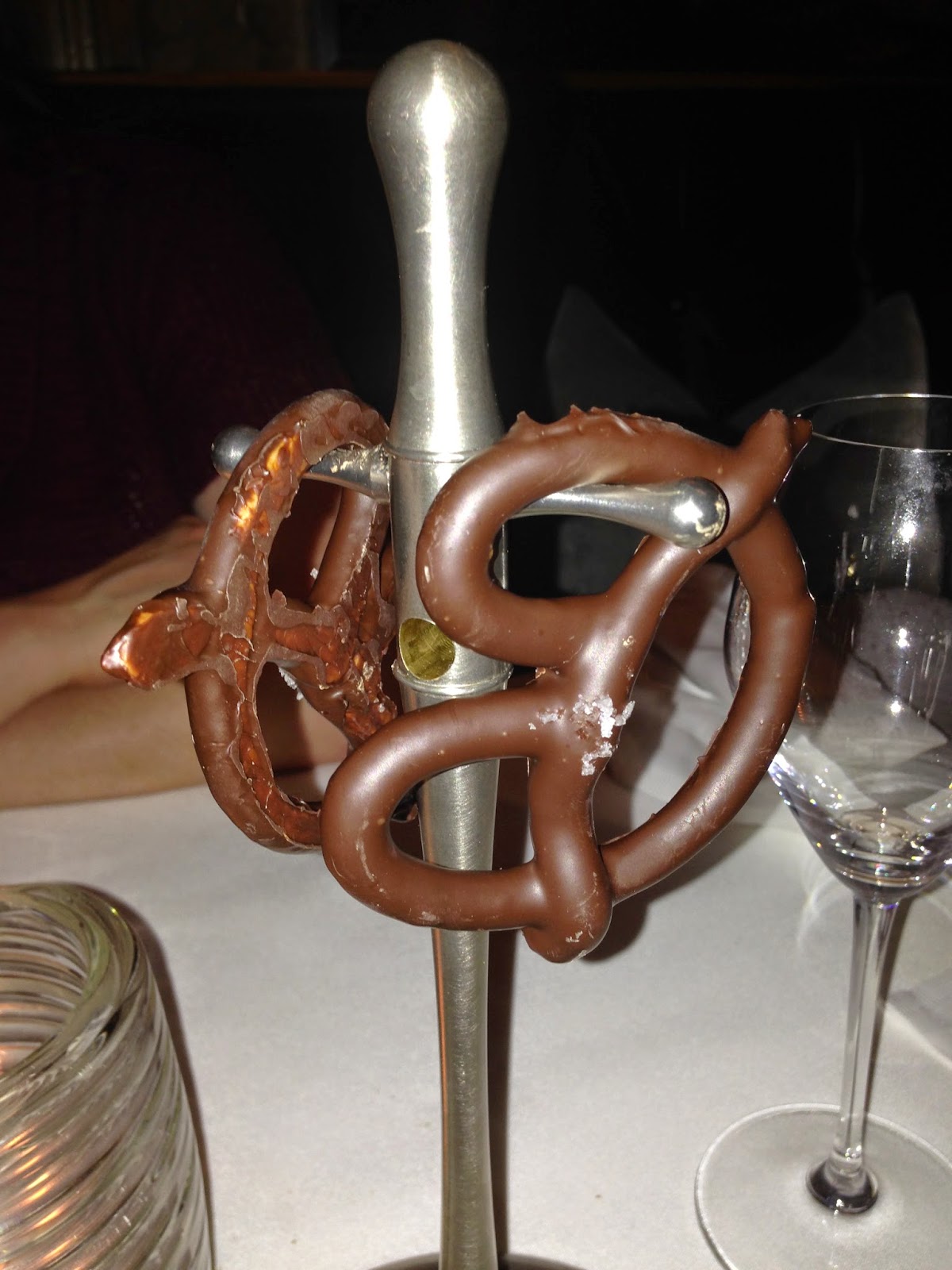
Do you think we're done? We're not done. House made hard salted pretzels, dipped in dark chocolate, served with an entire bottle of apple brandy to drink at our leisure. We did not drink an entire bottle of apple brandy. I liked the saltiness of the pretzels with the dark, bittersweet chocolate. And the closing black and white cookies, sweet this time - chocolate with apple molasses.
As a closing salvo, they sent us each home with a mason jar of house made granola for future breakfasts, and a decadent chocolate bar for me, also for my birthday. After all that food, and all that wine, we opted to walk the 25 or so blocks back to our hotel.
This was an epoch meal. The sort that comes but rarely. Expensive, yes, but I don't regret one penny spent. It was a glorious and unforgettable evening, and memory that will stay with me forever.
For updates and observations, follow me on twitter! @culinarykira
Tacos are magic!
Hello foodies!
Happy 2015! I am declaring this the year of the taco!
My love of tacos is growing into an obsession. Are they the world's most perfect food? Let's discuss.
Just had to get a picture in there. These are the tacos de lengua I made from scratch as part of my experiments with cooking tongue.
Some personal history... My food background, as I have touched on before, is a very small town, WASP-y traditional background, so tacos were not a food I met early. When they were introduced to my family's dinner rotation, probably in the late 1980s, it was Old El Paso taco kits. Ground beef, cumin heavy spice mix, hard taco shells, ketchup-like salsa, iceberg lettuce, diced tomatoes, grated mild cheddar, and, if you wanted to be avant garde (and I did), a dollop of sour cream. Guacamole was still an alien concept to my clan back then. I loved them.
For the next 20 years, in my world, tacos remained unchanged, though still beloved. Then as food culture exploded, and the Food Network started to dominate, my eyes were opened to variations, a level of authenticity that Old El Paso just couldn't offer. Flavourful grilled meats (al pastor, carne asada), fresh flour tortillas, soft corn tortillas, fresh cilantro, crema, lime juice, guacamole, or just plain sliced avocado. Salsa verde. Fish!! There was a whole new taco world I was seeing on TV, and I wanted to taste them. Taste them all.
In Ottawa, restaurant choices remained limited. Mexicali Rosa's, for the most part. Not much of a step above Old El Paso. But then, about 3 years ago, Ottawa's taco world started to bloom. Now decent tacos are available in pubs and chain restaurants like Lone Star and Moxie's. But there are brighter lights.
Tacos are a staple at Side Door, in the Byward Market (click here for my review), and that was probably where I first tasted the true magic that is a taco. Here are their fish tacos, and I also LOVE their spicy beef tacos. They have 5 standard offerings (including a vegetarian taco), as well as a chef's feature, which changes often.
What makes tacos so perfect is that, when done right, they offer a little bit of everything in every bite, and there are SO MANY OPTIONS. A good taco has contrasts in texture - crisp veg like radish and cabbage, crispy elements like char on meat or batter on fish vs soft, things like a soft, fresh tortilla, the yielding meat or fish, creamy sour cream, or guac, or simple sliced avocado. Temperature contrasts - hot tortilla and meat or fish, and cool veg and other toppings. Richness (meat) vs freshness (veg, cilantro, salsas, acid elements like lime juice). Spiciness (salsas, peppers, spicy braised meats) vs cooling elements (sour cream, crema). Sweetness (mango, pineapple and other fruits can play a role in salsas and sauces) vs savouriness. Every bite is different. Every bite is perfect in and of itself.
The beauty of tacos is that they are street food. Accessible. Generally inexpensive. I want a taco truck in Ottawa. I need a taco truck in Ottawa. But I digress... Because of this some places more akin to fast food joints have cropped up. Burrito Gringo - not my favourite, but decent enough, and if it is nearby when a taco craving hits, they'll definitely do. Burrito Borracho. I like this place. Small seating area that works as a traditional restaurant, and a takeout counter above it. Several options for meats and salsas, so you can tailor your taco to your tastes. And very affordable, with tacos ranging in price from $3.50 to $4.25 (for the very delightful Baja style fish taco). From left to right, we have pulled pork, Baja style fish, and al pastor.
For a long time, fish tacos were my taco holy grail. And they are awesome. But then I discovered tacos de lengua. Tongue tacos. And they are awesome. They are also a little harder to find. El Camino, on Elgin Street, in Ottawa, serves, in my opinion, the best tacos in Ottawa. And the jewel in their crown is their ox tongue taco.
El Camino is a very popular restaurant. They are open for dinner, but they do not take reservations. I have never been there to eat in, though I hear it is great - excellent tequila selection, food gets good marks. They also have a window. A taco window. Cash only, open for lunch Tuesday to Friday, and evenings and late nights (very popular with after bar crowd). Their tacos are pretty big. So while slightly more expensive than Burrito Borracho, you need fewer to satisfy. Pictured is a fish taco (left), and the ox tongue taco. Flour tortillas are made in house. The ox tongue taco, to me, is beefiness at its best. Grilled, a little charred, intense beef flavour, lovely texture, and all the elements of a great taco discussed above. I pick up my tacos and walk to a nearby park to enjoy a truly satisfying meal (although, I admit the park think is less pleasant in the depths of an Ottawa winter).
Trying El Camino's tongue taco inspired me to make my own (the first picture, above). The idea of tongue grosses many out. But really, it is muscle tissue, just like most of the other beef we eat. It is a more flavourful cut because the tongue is a working muscle. Braise with onions, carrots and spices, peel (this is the part that may freak people out), then dice. Crisp up in a hot pan, and you have taco glory. The glory of cooking tongue may form part of another post.
Also... Why do people ever buy flour tortillas from a grocery store? They are like eating construction paper. Tortillas are SO EASY to make at home. Better texture. Better taste.
I think I have made my case for tacos. They are magic - go forth and enjoy!
For updates and observations, follow me on twitter @culinarykira !
Happy 2015! I am declaring this the year of the taco!
My love of tacos is growing into an obsession. Are they the world's most perfect food? Let's discuss.
Just had to get a picture in there. These are the tacos de lengua I made from scratch as part of my experiments with cooking tongue.
Some personal history... My food background, as I have touched on before, is a very small town, WASP-y traditional background, so tacos were not a food I met early. When they were introduced to my family's dinner rotation, probably in the late 1980s, it was Old El Paso taco kits. Ground beef, cumin heavy spice mix, hard taco shells, ketchup-like salsa, iceberg lettuce, diced tomatoes, grated mild cheddar, and, if you wanted to be avant garde (and I did), a dollop of sour cream. Guacamole was still an alien concept to my clan back then. I loved them.
For the next 20 years, in my world, tacos remained unchanged, though still beloved. Then as food culture exploded, and the Food Network started to dominate, my eyes were opened to variations, a level of authenticity that Old El Paso just couldn't offer. Flavourful grilled meats (al pastor, carne asada), fresh flour tortillas, soft corn tortillas, fresh cilantro, crema, lime juice, guacamole, or just plain sliced avocado. Salsa verde. Fish!! There was a whole new taco world I was seeing on TV, and I wanted to taste them. Taste them all.
In Ottawa, restaurant choices remained limited. Mexicali Rosa's, for the most part. Not much of a step above Old El Paso. But then, about 3 years ago, Ottawa's taco world started to bloom. Now decent tacos are available in pubs and chain restaurants like Lone Star and Moxie's. But there are brighter lights.
Tacos are a staple at Side Door, in the Byward Market (click here for my review), and that was probably where I first tasted the true magic that is a taco. Here are their fish tacos, and I also LOVE their spicy beef tacos. They have 5 standard offerings (including a vegetarian taco), as well as a chef's feature, which changes often.
What makes tacos so perfect is that, when done right, they offer a little bit of everything in every bite, and there are SO MANY OPTIONS. A good taco has contrasts in texture - crisp veg like radish and cabbage, crispy elements like char on meat or batter on fish vs soft, things like a soft, fresh tortilla, the yielding meat or fish, creamy sour cream, or guac, or simple sliced avocado. Temperature contrasts - hot tortilla and meat or fish, and cool veg and other toppings. Richness (meat) vs freshness (veg, cilantro, salsas, acid elements like lime juice). Spiciness (salsas, peppers, spicy braised meats) vs cooling elements (sour cream, crema). Sweetness (mango, pineapple and other fruits can play a role in salsas and sauces) vs savouriness. Every bite is different. Every bite is perfect in and of itself.
The beauty of tacos is that they are street food. Accessible. Generally inexpensive. I want a taco truck in Ottawa. I need a taco truck in Ottawa. But I digress... Because of this some places more akin to fast food joints have cropped up. Burrito Gringo - not my favourite, but decent enough, and if it is nearby when a taco craving hits, they'll definitely do. Burrito Borracho. I like this place. Small seating area that works as a traditional restaurant, and a takeout counter above it. Several options for meats and salsas, so you can tailor your taco to your tastes. And very affordable, with tacos ranging in price from $3.50 to $4.25 (for the very delightful Baja style fish taco). From left to right, we have pulled pork, Baja style fish, and al pastor.
For a long time, fish tacos were my taco holy grail. And they are awesome. But then I discovered tacos de lengua. Tongue tacos. And they are awesome. They are also a little harder to find. El Camino, on Elgin Street, in Ottawa, serves, in my opinion, the best tacos in Ottawa. And the jewel in their crown is their ox tongue taco.
El Camino is a very popular restaurant. They are open for dinner, but they do not take reservations. I have never been there to eat in, though I hear it is great - excellent tequila selection, food gets good marks. They also have a window. A taco window. Cash only, open for lunch Tuesday to Friday, and evenings and late nights (very popular with after bar crowd). Their tacos are pretty big. So while slightly more expensive than Burrito Borracho, you need fewer to satisfy. Pictured is a fish taco (left), and the ox tongue taco. Flour tortillas are made in house. The ox tongue taco, to me, is beefiness at its best. Grilled, a little charred, intense beef flavour, lovely texture, and all the elements of a great taco discussed above. I pick up my tacos and walk to a nearby park to enjoy a truly satisfying meal (although, I admit the park think is less pleasant in the depths of an Ottawa winter).
Trying El Camino's tongue taco inspired me to make my own (the first picture, above). The idea of tongue grosses many out. But really, it is muscle tissue, just like most of the other beef we eat. It is a more flavourful cut because the tongue is a working muscle. Braise with onions, carrots and spices, peel (this is the part that may freak people out), then dice. Crisp up in a hot pan, and you have taco glory. The glory of cooking tongue may form part of another post.
Also... Why do people ever buy flour tortillas from a grocery store? They are like eating construction paper. Tortillas are SO EASY to make at home. Better texture. Better taste.
I think I have made my case for tacos. They are magic - go forth and enjoy!
For updates and observations, follow me on twitter @culinarykira !
Friday, 13 June 2014
Poisson en Papillote (Fish in a Bag)
Hello foodies!
Recently, I took a bistro classics cooking class at The Urban Element. The class was taught by Patricia Larkin, the chef at The Black Cat Bistro, a restaurant specializing in French bistro fare. The class taught us to make a number of the items which appear on The Black Cat Bistro's menu, dispelling fears that all French food is fussy and demanding, and out of the reach of most home cooks. While I don't see myself often throwing together a brioche here at home, one of the dishes I have put into regular rotation is the poisson en papillote.
This is my fish from the class:
There is much about this dish that appeals. The vibrancy of the colours. The gorgeous aroma as you open the packet. The fact that it is really quite a healthy dish. And, most of all, its versatility. Every single pickerel en papillote made that night was a little different in the end because each person put their own together, based on their own preferences. A dish that I can change based on my mood and on what ingredients are available appeals greatly to me.
Essentially, the dish is a piece of fish, generally a white fish, resting on a bed of vegetables and aromatics, then loosely sealed in a parchment paper bag and baked in the oven until the fish is just cooked. Cozy in the parchment paper bag, the fish steams, taking on some of the flavours of what is sealed in with it, liquids are released from fish and veg, blending with the dab or oil and/or butter to form a heavenly broth/liquor in the bottom of the bag.
To start, you need small pieces of vegetables, something that will cook enough - but not overcook - in the 20 minutes or so it takes for the fish to cook. If you want potatoes in your bag, you'll need to parboil them. Using the julienne setting of my peeler (pictured), I made zucchini strings as my base. (Momentary digression: I LOVE this peeler. I generally detest peeling vegetables and resist making any dish that will require me to peel. This peeler is causing me to rethink my position on peeling. Comfortable in the hand, it makes quick work of peeling, and has different blades for different effects. The end.)
To the zucchini strings, I added fennel, spinach, arugula, shallots, cherry tomatoes, and a pinch of salt and pepper. Right before laying the fish on it's bed, I added a couple of dill fronds.
I used halibut when making it at home. A fairly thick filet, known for its firm, fine texture. But pretty much any white fish would do. A pat of butter (olive oil works, too, or even a bit of both), more salt and pepper, a squeeze of lemon or lime.
To seal, fold the parchment paper over, and start rolling and crimping to work your way around the open side. You don't want it too tight, but you do want a decent seal so that the steam and liquid won't escape, letting the fish dry out. 350 degree oven for 20 minutes or so. Thicker fillets may need longer time. Something thinner, like sole, would not need as much. If you're not sure, it is easy enough to cut a small slit in the back to check the doneness of the fish. If it needs more time, pinch the slit closed and slide it back in the oven.
It is quite easy to slide it from the parchment packet onto a plate. Or you can simply serve it in the packet and eat it from the bag.
As we head into summer, when vegetables are at their height, I imagine what delightful variations I can make on this dish. I think sweet corn kernels may go quite nicely. Celeriac might work. Baby carrots. Ginger might work for some flavour, depending on what else I put in it. A splash of wine or liquor instead of a squeeze of citrus. The possibilities are endless.
For updates and observations, follow me on Twitter! @culinarykira
Recently, I took a bistro classics cooking class at The Urban Element. The class was taught by Patricia Larkin, the chef at The Black Cat Bistro, a restaurant specializing in French bistro fare. The class taught us to make a number of the items which appear on The Black Cat Bistro's menu, dispelling fears that all French food is fussy and demanding, and out of the reach of most home cooks. While I don't see myself often throwing together a brioche here at home, one of the dishes I have put into regular rotation is the poisson en papillote.
This is my fish from the class:
There is much about this dish that appeals. The vibrancy of the colours. The gorgeous aroma as you open the packet. The fact that it is really quite a healthy dish. And, most of all, its versatility. Every single pickerel en papillote made that night was a little different in the end because each person put their own together, based on their own preferences. A dish that I can change based on my mood and on what ingredients are available appeals greatly to me.
Essentially, the dish is a piece of fish, generally a white fish, resting on a bed of vegetables and aromatics, then loosely sealed in a parchment paper bag and baked in the oven until the fish is just cooked. Cozy in the parchment paper bag, the fish steams, taking on some of the flavours of what is sealed in with it, liquids are released from fish and veg, blending with the dab or oil and/or butter to form a heavenly broth/liquor in the bottom of the bag.
To start, you need small pieces of vegetables, something that will cook enough - but not overcook - in the 20 minutes or so it takes for the fish to cook. If you want potatoes in your bag, you'll need to parboil them. Using the julienne setting of my peeler (pictured), I made zucchini strings as my base. (Momentary digression: I LOVE this peeler. I generally detest peeling vegetables and resist making any dish that will require me to peel. This peeler is causing me to rethink my position on peeling. Comfortable in the hand, it makes quick work of peeling, and has different blades for different effects. The end.)
To the zucchini strings, I added fennel, spinach, arugula, shallots, cherry tomatoes, and a pinch of salt and pepper. Right before laying the fish on it's bed, I added a couple of dill fronds.
I used halibut when making it at home. A fairly thick filet, known for its firm, fine texture. But pretty much any white fish would do. A pat of butter (olive oil works, too, or even a bit of both), more salt and pepper, a squeeze of lemon or lime.
To seal, fold the parchment paper over, and start rolling and crimping to work your way around the open side. You don't want it too tight, but you do want a decent seal so that the steam and liquid won't escape, letting the fish dry out. 350 degree oven for 20 minutes or so. Thicker fillets may need longer time. Something thinner, like sole, would not need as much. If you're not sure, it is easy enough to cut a small slit in the back to check the doneness of the fish. If it needs more time, pinch the slit closed and slide it back in the oven.
It is quite easy to slide it from the parchment packet onto a plate. Or you can simply serve it in the packet and eat it from the bag.
As we head into summer, when vegetables are at their height, I imagine what delightful variations I can make on this dish. I think sweet corn kernels may go quite nicely. Celeriac might work. Baby carrots. Ginger might work for some flavour, depending on what else I put in it. A splash of wine or liquor instead of a squeeze of citrus. The possibilities are endless.
For updates and observations, follow me on Twitter! @culinarykira
Wednesday, 11 June 2014
Raw Meat
Hello foodies!
There is so much to write about!
In preparation for blogging, I transferred pics to my computer so they'd be poised for upload. In doing so, I noticed a theme: I like raw meat. Beef, specifically. Lots of people, of course, eat their beef medium, medium rare, or even blue. Many say eating beef any more than medium is an insult to the animal that gave its life. I don't completely agree with this assessment. A rare boeuf bourguignon is not a good thing. Lamb is also often enjoyed medium or medium rare. Game birds as well - duck, goose, quail - also don't have to be cooked through. Modern thinking even allows pork to have a trace of pink in the centre. But there is a difference between the pink, or even reddish centre, and purely raw.
Steak tartare and beef carpaccio is where the line is drawn. Tartare, finely minced (but not simply ground beef - best done by hand), wonderfully textured and beautifully seasoned. Carpaccio, thinly sliced and cured with a hit of acid, like lemon juice. These dishes have never seen a lick of heat. This is where you get beef at its purest. Its beefiest. This is where you can't hide mistakes. Unimpeachable quality is required. Exemplary food handling is essential. And, if making it yourself, excellent knife skills are the starting point.
I feel at this point, we need a picture.
Isn't that pretty? This is the tartare I made at a recent cooking class at the Urban Element, a local foodie hotspot where I have spent many a delightful hour learning new techniques and connecting with the local foodies.
Now, some exposition.
Steak tartare. Minced beef, traditionally done by hand. Seasoned with shallots, cornichons (gherkins, for those unused to French terminology), Dijon, capers, salt and pepper, Worcestershire sauce, oil, plus a variety of other seasonings dependent on the particular tastes of the person making it. Chives. Soy sauce. Tabasco. Chili flakes. Parsley. It is really a flexible and forgiving dish. Also essential to a proper tartare is egg yolk, which binds and adds a luxurious unctuousness. Served with some delivery method that gets the beef from the plate to your mouth: melba toast, toast points, potato chips, etc.
Beef carpaccio. Thinly sliced beef, artfully arranged, dressed simply. An acid element, such as lemon juice. an oil. Salt and pepper. Shavings of parmigiano, or some other cheese with character. Often a crunchy element is on the plate. Chip, crispy onion strings.
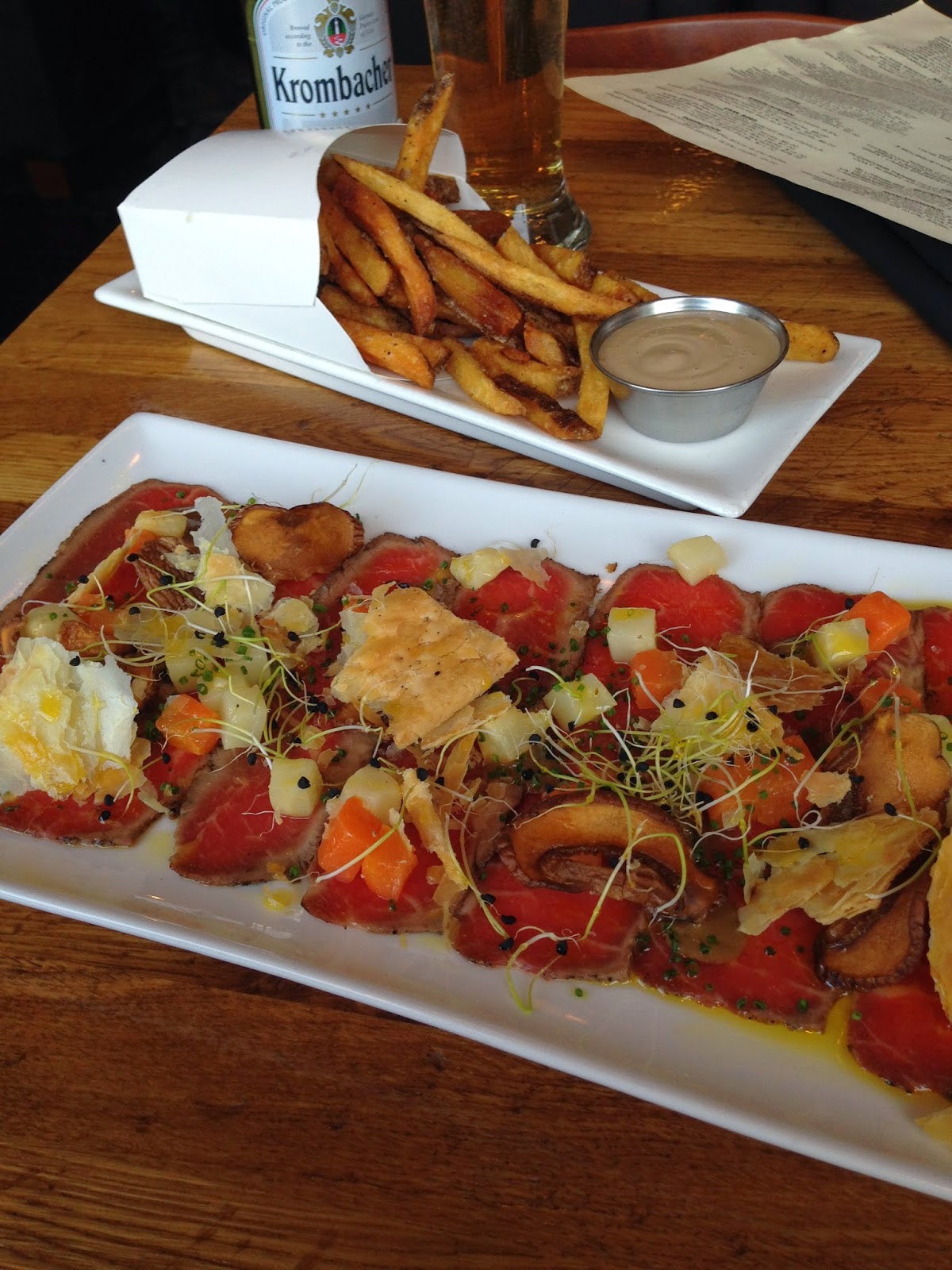
This is the carpaccio from Brother's Beer Bistro. The crispy elements are pie crust and mushrooms. Freshness comes from the cold, smooth root vegetable cubes and the sprouts. Olive oil, lemon, and a beer based sauce round out the dish.
These dishes exist at the meeting point between creativity, excellent technique and quality ingredients. They are not out of reach for the home chef.
First, you need an excellent meat supplier. A mainstream, chain grocery store simply will not do, since you have no idea what has been needle tenderized. Unless a meat is going to be cooked to a minimum temperature (not raw), you need to be confident that its structural integrity hasn't been compromised. Many, if not most, chain grocery stores receive their meat pre-packaged from meat packaging plants. Needle tenderizing, where needles are forced into the tissue, depositing whatever bacteria are on the needles or the surface of the meat, is widely used. Labelling requirements are inconsistent. If you are going to try a raw preparation, you need a purveyor you can trust. In Ottawa there are several: Glebe Meat Market, Saslove's, Aubrey's. A hint: if quality restaurants use a butcher as a meat supplier, it is a good sign that they are reliable. There may be others, but those are my go-tos.
There are a variety of cuts you can use, but in general, they are among the more tender. Traditionally, tenderloin is often used. But striploin, rib, or even heart are appearing on menus.
Second, an excellent knife. Sharp. German or Japanese. Many get suckered in to a butcher's block filled with mediocre knives. There are few you truly need: a chef's knife, a paring knife. If you're interested in your own butchering, maybe a boning knife, although, seriously, I seldom find myself reaching for anything other than my 8 inch chef's knife. Where knives are concerned, you want quality over quantity. Personally, I go German. Wustof, Henckels. I look for balance. Feeling right in my hand. A certain weight. I'd rather spend $120 on one awesome blade that I will use constantly than $120 on a panoply of crap that looks cool on my counter. Invest in a proper sharpening steel to keep them honed between more formal sharpenings. Either learn how to sharpen yourself using a whetstone, or get your blades sharpened professionally on a regular basis. Treat a good blade properly, and it will last you for decades. From a safety perspective, though it is counter-intuitive, a sharp blade is safer than a dull one. The sharper the blade, the truer the cut. The less likely it will jump, slide, or otherwise misbehave. And it won't shred. If you happen to cut yourself, you'll appreciate a knife that cuts cleanly rather than one that shreds your skin.
Third, the meat, when cutting, either the mince for a tartar or the thin slices for a carpaccio, should be very, very cold. Putting it in the freezer for 20 minutes helps. This helps it to maintain its structural integrity when cutting. As much as many don't like to think of it, the meat we eat is muscle tissue. It breaks down and becomes mushy with excessive handling. Working with very cold beef helps to protect the texture of the meat, which is a huge part of the appeal of either tartare or carpaccio.
After that... It's up to you. You need some acid. You need some fat. You need some crunch. But the world is your oyster. Or, your plate of raw beef.
When I do carpaccio, I sprinkle salt on the meat, wrap it tightly for an hour or so to impart flavour and cure while in the fridge. Transfer to the freezer to firm up, slice thinly, and serve with lemon juice, walnut oil, shaved parmigiano, and thinly sliced onions dredged in cornstarch and dry fried.
The best tartare I ever had was at the Ottawa Wine and Food show a couple of years ago, an offering by the Wakefield Inn. Then, it was a bison tartare, but what sticks in my memory were the little balls of soy sauce, created by molecular gastronomy wizardry. As they exploded in my mouth along with the perfectly textured, flavourful bison it was a game changer for me. The best bite of that particular food and wine show, and since then, when I make tartare at home, I include a splash of soy sauce to recreate that taste.
A couple more pics...
My own carpaccio at home.
Aperitivo's tartare
There is so much to write about!
In preparation for blogging, I transferred pics to my computer so they'd be poised for upload. In doing so, I noticed a theme: I like raw meat. Beef, specifically. Lots of people, of course, eat their beef medium, medium rare, or even blue. Many say eating beef any more than medium is an insult to the animal that gave its life. I don't completely agree with this assessment. A rare boeuf bourguignon is not a good thing. Lamb is also often enjoyed medium or medium rare. Game birds as well - duck, goose, quail - also don't have to be cooked through. Modern thinking even allows pork to have a trace of pink in the centre. But there is a difference between the pink, or even reddish centre, and purely raw.
Steak tartare and beef carpaccio is where the line is drawn. Tartare, finely minced (but not simply ground beef - best done by hand), wonderfully textured and beautifully seasoned. Carpaccio, thinly sliced and cured with a hit of acid, like lemon juice. These dishes have never seen a lick of heat. This is where you get beef at its purest. Its beefiest. This is where you can't hide mistakes. Unimpeachable quality is required. Exemplary food handling is essential. And, if making it yourself, excellent knife skills are the starting point.
I feel at this point, we need a picture.
Isn't that pretty? This is the tartare I made at a recent cooking class at the Urban Element, a local foodie hotspot where I have spent many a delightful hour learning new techniques and connecting with the local foodies.
Now, some exposition.
Steak tartare. Minced beef, traditionally done by hand. Seasoned with shallots, cornichons (gherkins, for those unused to French terminology), Dijon, capers, salt and pepper, Worcestershire sauce, oil, plus a variety of other seasonings dependent on the particular tastes of the person making it. Chives. Soy sauce. Tabasco. Chili flakes. Parsley. It is really a flexible and forgiving dish. Also essential to a proper tartare is egg yolk, which binds and adds a luxurious unctuousness. Served with some delivery method that gets the beef from the plate to your mouth: melba toast, toast points, potato chips, etc.
Beef carpaccio. Thinly sliced beef, artfully arranged, dressed simply. An acid element, such as lemon juice. an oil. Salt and pepper. Shavings of parmigiano, or some other cheese with character. Often a crunchy element is on the plate. Chip, crispy onion strings.
This is the carpaccio from Brother's Beer Bistro. The crispy elements are pie crust and mushrooms. Freshness comes from the cold, smooth root vegetable cubes and the sprouts. Olive oil, lemon, and a beer based sauce round out the dish.
These dishes exist at the meeting point between creativity, excellent technique and quality ingredients. They are not out of reach for the home chef.
First, you need an excellent meat supplier. A mainstream, chain grocery store simply will not do, since you have no idea what has been needle tenderized. Unless a meat is going to be cooked to a minimum temperature (not raw), you need to be confident that its structural integrity hasn't been compromised. Many, if not most, chain grocery stores receive their meat pre-packaged from meat packaging plants. Needle tenderizing, where needles are forced into the tissue, depositing whatever bacteria are on the needles or the surface of the meat, is widely used. Labelling requirements are inconsistent. If you are going to try a raw preparation, you need a purveyor you can trust. In Ottawa there are several: Glebe Meat Market, Saslove's, Aubrey's. A hint: if quality restaurants use a butcher as a meat supplier, it is a good sign that they are reliable. There may be others, but those are my go-tos.
There are a variety of cuts you can use, but in general, they are among the more tender. Traditionally, tenderloin is often used. But striploin, rib, or even heart are appearing on menus.
Second, an excellent knife. Sharp. German or Japanese. Many get suckered in to a butcher's block filled with mediocre knives. There are few you truly need: a chef's knife, a paring knife. If you're interested in your own butchering, maybe a boning knife, although, seriously, I seldom find myself reaching for anything other than my 8 inch chef's knife. Where knives are concerned, you want quality over quantity. Personally, I go German. Wustof, Henckels. I look for balance. Feeling right in my hand. A certain weight. I'd rather spend $120 on one awesome blade that I will use constantly than $120 on a panoply of crap that looks cool on my counter. Invest in a proper sharpening steel to keep them honed between more formal sharpenings. Either learn how to sharpen yourself using a whetstone, or get your blades sharpened professionally on a regular basis. Treat a good blade properly, and it will last you for decades. From a safety perspective, though it is counter-intuitive, a sharp blade is safer than a dull one. The sharper the blade, the truer the cut. The less likely it will jump, slide, or otherwise misbehave. And it won't shred. If you happen to cut yourself, you'll appreciate a knife that cuts cleanly rather than one that shreds your skin.
Third, the meat, when cutting, either the mince for a tartar or the thin slices for a carpaccio, should be very, very cold. Putting it in the freezer for 20 minutes helps. This helps it to maintain its structural integrity when cutting. As much as many don't like to think of it, the meat we eat is muscle tissue. It breaks down and becomes mushy with excessive handling. Working with very cold beef helps to protect the texture of the meat, which is a huge part of the appeal of either tartare or carpaccio.
After that... It's up to you. You need some acid. You need some fat. You need some crunch. But the world is your oyster. Or, your plate of raw beef.
When I do carpaccio, I sprinkle salt on the meat, wrap it tightly for an hour or so to impart flavour and cure while in the fridge. Transfer to the freezer to firm up, slice thinly, and serve with lemon juice, walnut oil, shaved parmigiano, and thinly sliced onions dredged in cornstarch and dry fried.
The best tartare I ever had was at the Ottawa Wine and Food show a couple of years ago, an offering by the Wakefield Inn. Then, it was a bison tartare, but what sticks in my memory were the little balls of soy sauce, created by molecular gastronomy wizardry. As they exploded in my mouth along with the perfectly textured, flavourful bison it was a game changer for me. The best bite of that particular food and wine show, and since then, when I make tartare at home, I include a splash of soy sauce to recreate that taste.
A couple more pics...
My own carpaccio at home.
Aperitivo's tartare
For updates and observations, follow me on twitter! @culinarykira
Saturday, 10 May 2014
Brother's Beer Bistro
Hello foodies!
The Ottawa restaurant scene has become more exciting over the last couple of years. I have a list of restaurants I am making my way through. New places I want to try always being added as others get crossed off. Today, I want to talk about Brother's Beer Bistro.
The atmosphere is relaxed. Big windows, so the space is fairly bright (I was there for lunch both times), exposed brick walls for that factory/industrial vibe. Servers are friendly. It can be a little slow, particularly when waiting for the bill, but that is really my only (small) complaint.
As you may be able to guess from the name of the restaurant, Brother's is all about the beer. They have an extensive beer list. They make beer cocktails. Each dish has a recommended beer pairing. Every dish has beer as an ingredient in some way (although they can make many of their dishes beer-free to accommodate dietary or religious restrictions). Their website has a blog about beer. So if you like beer......
This dish has a lot going on, and all of it good. First, there is the meat. Cold, flavourful, quality beef short rib sliced paper thin. Beautiful texture (I find with raw preparations of both meat and fish, texture is almost more important than taste). Excellent olive oil. Little sprouts. There were little cubes of cold root vegetables: carrots, parsnips, they provided a nice counterpoint. Most interesting was the crunch aspect: crispy pie dough. As someone who often finds the crust the best part of a pie, this appealed.
On a different visit, I opted for charcuterie:
Visually beautiful, I appreciated this dish greatly. It was an excellent combination of unctuous fat from the meat, aggressive acidity from the various pickles, and cooking neutrality from the cheese.
Another dish I tried was the smoked mackerel panzanelle:
Lots of interest here. What is most interesting is what is missing: the bread/crouton. A panzanelle is, by definition, about the stale bread. They handled the mistake well, offering to remake the salad. I declined, as I had a later engagement. And really, the salad was great even without the bread.
Returning to my first visit, there was the dessert:
The PB&J. As I have mentioned before, I am not a dessert person. But, on m first visit I ordered only one dish, so I felt the need to order dessert for blogging purposes. The dessert gets mixed reviews. The chocolate and peanut butter pot au creme was amazing. Lovely texture. Nicely complimented by the salty caramel corn. The cookie with strawberry jam was less successful. It didn't match conceptually or texturally with the pot au creme. It was a distraction from the main event. The pot au creme was truly lovely: smooth texture, intense flavour. The cookie and jam just didn't add to the dessert as a whole.
All in all, Brother`s gets a positive review. When I am looking for a place for an evening out, it is now one of the places I automatically check. Therefore, I recommend that you check it out, too.
Follow me on twitter: @culinarykira
The Ottawa restaurant scene has become more exciting over the last couple of years. I have a list of restaurants I am making my way through. New places I want to try always being added as others get crossed off. Today, I want to talk about Brother's Beer Bistro.
The atmosphere is relaxed. Big windows, so the space is fairly bright (I was there for lunch both times), exposed brick walls for that factory/industrial vibe. Servers are friendly. It can be a little slow, particularly when waiting for the bill, but that is really my only (small) complaint.
As you may be able to guess from the name of the restaurant, Brother's is all about the beer. They have an extensive beer list. They make beer cocktails. Each dish has a recommended beer pairing. Every dish has beer as an ingredient in some way (although they can make many of their dishes beer-free to accommodate dietary or religious restrictions). Their website has a blog about beer. So if you like beer......
If you don't like beer, I'd argue that you just haven't tried enough of it, because as this place so ably demonstrates, there is a beer out there for everyone. The servers are extremely knowledgeable, and are more than happy to make a recommendation. The server I had for both my visits gets extra points because he explained what I could expect flavour-wise from the recommended pairing: banana. To me, this is an abomination. But the fact that he explained the product so thoroughly allowed me to nix the standard pairing, and I was completely happy with the alternative he provided.
Now, the food. It was interesting and creative. On my first visit, I ordered short rib carpaccio.
On a different visit, I opted for charcuterie:
Visually beautiful, I appreciated this dish greatly. It was an excellent combination of unctuous fat from the meat, aggressive acidity from the various pickles, and cooking neutrality from the cheese.
Another dish I tried was the smoked mackerel panzanelle:
Lots of interest here. What is most interesting is what is missing: the bread/crouton. A panzanelle is, by definition, about the stale bread. They handled the mistake well, offering to remake the salad. I declined, as I had a later engagement. And really, the salad was great even without the bread.
Returning to my first visit, there was the dessert:
The PB&J. As I have mentioned before, I am not a dessert person. But, on m first visit I ordered only one dish, so I felt the need to order dessert for blogging purposes. The dessert gets mixed reviews. The chocolate and peanut butter pot au creme was amazing. Lovely texture. Nicely complimented by the salty caramel corn. The cookie with strawberry jam was less successful. It didn't match conceptually or texturally with the pot au creme. It was a distraction from the main event. The pot au creme was truly lovely: smooth texture, intense flavour. The cookie and jam just didn't add to the dessert as a whole.
All in all, Brother`s gets a positive review. When I am looking for a place for an evening out, it is now one of the places I automatically check. Therefore, I recommend that you check it out, too.
Follow me on twitter: @culinarykira
Subscribe to:
Posts (Atom)